Monday, July 23, 2018

Introducing: O5R Games

I am far enough ahead with Into the Unknown being print-ready, that the first two booklets just needs proper cover formatting to be print ready. And am basically 90% done with the remaining three. SO should be only a few months away now from a POD release.

Which also means I've set up O5R Games at onebookself.com. And at this point, I think the game needs a more focused platform than the blog I set up originally to riff on my homebrew setting.

So I've set up this new blog!

That is where all items related to Into the Unknown will go. But also anything OSR related and of general rpg interest. Basically the old blog will go back to being a blog about my homebrew setting and stuff I think only I would care about. I've migrated most of the posts I think belong in the former category to the new blog as well. You can expect this new blog to be busier than this one. In case you actually want to see my homebrew setting musings, you can check it out here:

https://mythlands-erce.blogspot.com

Thursday, December 21, 2017

System and Setting (+thoughts on ASSH)

I received +Jeff Talanian's Magnum Opus in the mail last week - The 2nd edition of ASTONISHING SWORDSMEN & SORCERERS OF HYPERBOREA (Jeff was a real gentleman and let me get in on the kickstarter run even though I missed the deadline).

It's kinda the opposite of what I am trying to do with Into the Unknown. It's built on the chassis of Advanced D&D 1e, while I am trying to build a modular 'un-advanced' edition of 5e. I am going for as lean as at all possible, with six booklets optimised for table play and 200 pages of gaming material being my top limit. ASSH is a massive 608-page hardbound single volume.

I am quite in awe of what Jeff has made though. The feel of the book alone, heavy from quality paper and binding, gives it potential to become one of those treasured tomes on many a gamer shelf. And the content is dead-on. I'd like to 'un-advance' a few bits here and there. But the classes, setting, monsters and spells are just dripping with ready-to-play S&S flavor that begs to be used.

I like to just hold it. It's that well made.

Which brings me to the point of this post - What ASSH does right is that it has no implied setting. Rather, its setting is fully explicit and everything in the rules is geared towards supporting that. It works. The monster list, the spells, even the class you play - all of it leaves you no doubt that you are playing a game of sword and sorcery - All of them are situated within the lands of Hyperborea beyond the North Wind. I can't think of a better way to establish the theme of a campaign.

Ranger fighting orc in D&D
Huntsman fighting a giant gorilla in ASSH
D&D wants to be a generic fantasy system, that you can then adapt to your own specific taste. This is a bit of a false assumptions though - Because the rules themselves carry their own implied setting. +Wayne Rossi showed how this is the case for OD&D - By the time of 5e, though D&D still sells itself as an adaptable generic fantasy system, it seems at least self-aware that by now D&D is basically its own genre of fantasy.

The downside of this is that when you adapt such a system to your own choice of genre, you end up with concessions to the implied genre of the game system. Your spells say nothing about the tone or workings of magic of your world. Your monsters neither. Classes and races only to the extent that some may be banned. Your monsters are picked from the same book as any other.

Really, setting publishers releasing D&D settings are too often taking the easy route. Any proper setting realise should have a fresh spellbook, its own set of classes, its own races and its own monster manual. At best we get a few choice additions for each.

Incidentally, this is why I think Dark Sun was such a well realised setting. Every class and race got a new entry in the Dark Sun rules. Only thieves were basically left untouched. And you get to play 4-armed bugs who like human flesh. Although spells were left untouched (a new spellbook just for Dark Sun would have been beyond awesome though), the way they worked was significantly altered - And with psionics so embedded, a distinct tone for the setting was set for this as well. And monsters - I don't recall ever using a non dark sun monster. The ones made for the setting just fit so much better. Even so, the list of monsters from existing generic compendiums that actually exist on Athas is limited to 36 critters. Fuck yeah. We don't ride horses or fight orcs. We ride Crodlu (upright lizards) and fight telepathic Belgoi that ring tiny bells to take over your mind, drain your CON with a touch and want to eat your flesh.
Belgoi - Upstaging orcs since 1991
ANYWAY....

The point being - Systems explicitly supporting a system really goes a long way towards supporting a setting. And the implied setting of generic systems can actually hold the realisation of your own setting back somewhat.

The upside of generic systems is of course that you don't have to learn a new rules system every time you want to try a new take on fantasy. And everyone knows D&D. But this is what I like about the OSR - We get spins where everyone knows the chassis being used - But with exactly these things being tailored to specific genres of fantasy. ASTONISHING SWORDSMEN & SORCERERS OF HYPERBOREA is just one example. Warriors of the Red Planet another. Fantastic Heroes & Witchery, though not geared towards one genre, understands that different genres require different rules and offers a variety of them. Dungeon Crawl Classics is Goodman Games' attempt to build a more genre attuned version of D&D.

So what does this mean for generic Into the Unknown? Well, one reason I think B/X was so popular is that being so lean makes it easier to build your own stuff on top to suit your needs. And I want to do the same with ItU - Basically to realise one of the stated design goals of 5e that were only half realised: Making a genuinely modular D&D. It's easier to add stuff from a lean base than take out stuff from a more complex base. So in the future, I hope to release a Sword & Sorcery module, with a different Classes book, Spell book and monster book. A Low Fantasy module. Etc.

In the future. For now, with playtest being open, I am just focusing on getting the basic system out the door.

Tuesday, December 19, 2017

Call for Playtesters - For "Into the Unknown" (B/X hack of 5e)

I've basically finished the DM Handbook - Still missing the treasure and monster book, but these should not be needed for review and testing. All the player material, save a bit of art and layouting in the magic booklet, is done.

SO - Anyone who would like to try out, or simply take a look at, a hack of 5e that harkens back to the simple days of B/X - where the rules properly support old-fashioned dungeon crawls and hexcrawls (and make them easy to run). Where reaction rolls, morale and race-as-class is still a thing.

Sign up to playtest "Into the Unknown"! Just join the playtest group here, and all the files will be made available to you. Any and all feedback is greatly appreciated.

https://plus.google.com/communities/104545421866073203092

Both there and on the blog, I will also be sharing designer notes in the upcoming weeks.

The proposed cover for the boxed set

Friday, November 10, 2017

"Social Combat" in D&D (B/X vs 3e/5e)

Writing the GM's guide for Into the Unknown has definitely been the biggest challenge of the project, forcing me to examine hard my own assumptions and understanding of what is good game mastering. But at this stage, I think we're close enough that playtest is only a few weeks away. All sections are laid out, page count is finalised - It just needs some text added to a handful of sections.

Blending 5e and B/X has been an excellent study in the differences between the two and trying to understand the implications of some of the changes. Reaction rolls and Morale for example, are among the more beloved parts of B/X that were abandoned in 3e and haven't been seen since. I've spent a fair bit of time examining both sides of the fence and figuring out which way to go.

Here's a sidebar I ended up adding to the section on social interaction that sums up how I feel social interaction should work in D&D:
“Social Combat”
The reaction roll is not a structured system, as combat rules, that should be rigidly interpreted and adhered to. It is meant as a creative inspiration to jolt the GM into thinking differently about encounters than one might habitually do. 
Nor are reactions just a DC for high rolls to beat, but a reflection of the NPC’s agency, that players may attempt to influence but can’t just overcome. 
As such, social ‘rules’ favor the more gradated and advisory reaction table over ability checks. Social interaction is a good time for remembering “When not to roll” and “Ability Scores & Proficiency Areas as Narrative Modifiers” 
When die rolls are made, use them to support the players’ social interaction, not replace it. As always, let the fiction dictate the action.
Unpacking all this, it may help to ask why 3e+ abandoned reaction and morale rolls and never looked back - The best reason I can find for this, is that it was replaced by an entirely different resolution mechanic that was not present in B/X - Skills.

With reaction & morale rolls, outcomes were a function of the NPC's mental attitude and fortitude reacting to its surroundings (of which PCs influencing the NPC was just one factor).

With the universal d20 resolution mechanic introduced in 3e, these were reduced to a target number (DC) - Basically making social mechanics akin to a Social Combat system - Roll high to overcome your opponent's resistance (DC).
Skills such as Intimidate and, most infamously, Diplomacy offer resolution mechanics to replace most of what the reaction and morale rolls handled in the past (one results of that being that fewer encounters ever flee in 3e+, unless prompted by a player "skill attack").
Maybe seeing monsters flee more often in B/X after failing morale rolls inspired old school players to run away more often too.
Nevermind the fact that with enough ranks, a "diplomancer" build in 3e was essentially casting "Dominate Person" at will (out of control numbers for this sort of thing was fixed in 4e/5e) - The issue with making it all a DC vs Player roll is that this isn't how these interactions work. 

A person's mental defences isn't being assaulted by some sort of telepathic attack, the outcome of which will produce a binary result (success/defeat) - He is being influenced, swayed towards a certain direction - And besides this is the fact that there is an unassailable defence any person has, that skill rolls struggle to account for - Deciding for oneself. 

The closest combat analogy for an influence skill roll is a Shove, pushing an opponent five foot in a certain direction. No target number or critical hit will shove a foe more than five 5, much less shove him all the way out of combat reach. And unlike a shove, an NPC can always decide to just ignore the push.

Any roll made should not be to determine whether the character succeeded in converting the other party to the desired position. It should simply be to determine how the other party decides to react on the situation - Modifiers can apply to such a roll of course, but it is a fundamentally different thing the die roll is resolving - The NPC's mindset as opposed to the player's skill.

So for Into the Unknown, I determined fairly quickly that Reactions & Morale rolls needed bringing back - They put the onus of the mechanic back where it belongs - The NPC rather than the one trying to influence the NPC - and make clear that what is being resolved is not "player chance of success vs a target's resistance", but basically just letting the dice decide how the NPC reacts instead of the GM, with ways for factoring in different circumstances (such as a player attempting to influence said reaction).

Since I already dropped skills (as D&D knows them), this was easily done, as no players will be left wondering what to do with his Persuasion and Intimidation skills when there are no ability checks to actually use them with.

Nonetheless, it is as true for Into the Unknown as it is for 5e, that there are social interactions where Charisma and proficiency are factors at work and any reaction and morale system susceptible to such factors needs to be able to account for them.

Without further ado, here is a pdf presenting all the rules for handling reactions and morale in Into the Unknown, which can be easily dropped into any 5e game.

Reactions & Morale for 5e / Into the Unknown [PDF]


Most of it will look extremely familar to B/X players. Explanatory note regarding terms in the sidebar on the last page: Itu replaces skills with "proficiency areas" and the rogue's skill Expertise with ability "Mastery" - They are sufficiently similar that they mean the same in this context.

As a side note, this also gives a nice preview of how the formatting and layout will be for Into the Unknown once it hits print.

Sunday, October 15, 2017

Setting Review II: Greyhawk


After Forgotten Realms, we move further back in time to take a look at the setting it knocked off its perch as the de facto setting at TSR - Gary Gygax's very own World of Greyhawk (I will, at times, be comparing the two settings for the very same reason).

Quick intro to the setting

(See also my review of the map of greyhawk - Incidentally, the most visited entry on my blog)
  • The world of Greyhawk is a Sword & Sorcery setting built on a proper medieval chassis with just a light sprinkling of Tolkien influences. 
  • It is built around a dichotomy of the lands of Men being relatively mundane, with the history and cultures of these having a suitably 'realistic' feel and the wilderness being home to the Weird - The place where adventurers go to experience the fantastical. Here, Greyhawk has a strong 'anything goes' approach where spaceships, timetravel, contact with other worlds, from the silly to the serious, are all within the tone of the setting.
  • It is a sparse and very open-ended setting characterised by no two greyhawk settings being quite the same, depending on how each DM interprets the setting.

Unpacking the above

I put each paragraph above in its own bullet point, because I feel they each need a bit of unpacking to really 'get' greyhawk. That it even needs this kind of unpacking is perhaps one reason that Forgotten Realms was such a smash hit in comparison.

A Sword & Sorcery setting built on a medieval chassis 

Compared to the Forgotten Realms, Greyhawk has a lot less influence from Tolkien. The primary inspirations that shine through are the Sword & Sorcery of Lieber's Fafhrd & The Gray Mouser and the more classical fantasy of Poul Anderson's Three Hearts & Three Lions.

Other sources can be inferred, but are not as clearly evidenced. What I mean by that is that Greyhawk assumes a different generation of fantasy enthusiasts. For people who had already read Jack Vance's The Dying Earth or Michael Moorcock's Elric it is easy to see how these influences fit like a glove for creating a richer framework of Gygax's greyhawk. But they are not essential for the core of it (more on this below).

Gygax is better schooled in medievalism than Greenwood and it shows in his setting history and how it shows a pattern of cultural development. On a scale of Harn to Legoland realism, Greyhawk, in certain ways, leans much closer to the Harn side. We are meant to know that feudalism had a historical origin here, that peasants get killed in petty wars of nobility and that trade follows pseudo-realistic patterns.  
The clear medieval character (surprisingly rare in fantasy) of it makes it more analogous to Game of Thrones than any other D&D settings (except maybe Birthright).

The lands of Men are Mundane & the Wilderness home to the Weird

An article in Dragon Magazine #40, "Believe it or not, Fantasy has reality", spells out an implied assumption of Greyhawk that is crucial to understanding how it is more than a semi-realistic, but ultimately somewhat bland, medievalist setting:
“...There is an essential element which will determine the success or failure of a game as High Fantasy: the division of the world into Home Areas and Wyrd Areas.
A Home Area is one in which everyday life as we know it exists; it is the Primary World.
A Wyrd Area is the realm of the Dark, the actual world of Faerie. It is in Wyrd Areas that one encounters monsters and has adventures. All AD&D dungeons are Wyrd Areas."
The world described in the original Greyhawk Folio and Boxed Set is mostly the mundane 'home area' world. What neither does a very good job of showing, but which is made abundantly clear by the modules situated in Greyhawk, such as EX1 Dungeonland, EX2 The Land Beyond the Magic Mirror and WG6 Isle of the Ape, is that once you cross into the wilderness, Greyhawk becomes more akin to a gritty Alice in Wonderland, that is awash in Weird Things from interplanetary timetravel, spaceships and robots, to extra-dimensional horrors and whatever else a DM could dream up (lest we forget - The drow were originally a surprise 'evil elf' race unveiled in an adventure and were very much a signature race of greyhawk before Forgotten Realms popularised them further). 

There was a clear assumption of No Holds Barred when it came to the Weird and whatever fantastical stuff you wanted to throw at your PCs would never interfere with the tone or style of the setting. Here, Jack Vance's Dying Earth and Planet of Adventure take over as unstated influences and the baroque, absurd and humoristic character of Greyhawk begins to show itself.

Another assumption to bear in mind, also unstated, is that Greyhawk assumed picaresque adventurers having episodic adventures that could as often venture into the absurd as it did the heroic. As opposed to the more epic quests and heroes that modern audiences might assume as their D&D default, owing to their  modern literary fantasy influences.

Much of this could be self-evident to those who had the folio, a few published adventures and had read much of the same kind of literature that Gygax had soaked in. It is not at all clear to younger audiences, or even older ones who didn't have the same influences (or, those who had but didn't necessarily infer that these influenced were to be imputed). 

A modern World of Greyhawk setting would need to devote a fair amount of pages to elucidate to modern audiences its tone, style, literary influences and hitherto unstated assumptions in order to really be 'got'. 
As such, it has to be said the Greyhawk has not aged as well as some settings (though its kinship with Game of Thrones may have given it new modern appeal) and the bar of entry is somewhat high to younger players.

A Sparse & Open-ended Setting

The saving grace of Greyhawk is that all of the unstated assumptions above are not necessary to use it well.
"The world of greyhawk is yours now -- Yours to do with as you wish. You can mold new states out of old ones or inflame ancient rivalries into open warfare as you tailor the world to suit the needs of your players."
Naturally, many DMs take it as a given that they can adapt existing settings to suit their needs - But unlike most modern settings, Greyhawk was always intended as a chassis for DMs to customise and make their own. For similar reasons, though detailed in some areas, it is intentionally sparse in others.

As such, Greyhawk really should be mostly evaluated on its suitability as a gaming chassis to get DMs started with and how easy it is for DMs to pour their creativity into and make it their own. It lends itself as easily to gritty "game of thrones" style gritty low fantasy as it does to "Paladins & Princesses" or Lieber-esque sword & sorcery.

A Note on Later Developments

This review assumes the default line of the original Folio and boxed set. As was obligatory for all TSR settings during the 90s, Greyhawk was blown up by a Big Event. In Greyhawk's case, they took all the seeds of conflict scattered across the original material and triggered them all at once - Thus the Greyhawk Wars and with it the new campaign set From the Ashes by Carl Sargent. 

The Greyhawk Wars altered the tone of the setting significantly. The original version was an open-ended setting with no overarching angle or theme, where the geopolitics is tightly strung in many places, but where events in the wilderness could just as well be influential. Hooks were set as dials for the DM to turn when he wanted stuff to happen.

The setting of From the Ashes was one where geopolitics is the dominant theme of the setting and evil definitely has the upper hand and you can't visit a village anywhere without having to deal with some fallout or another of the wars. More Darkhawk than Greyhawk.

As a result, true to its original intention, many greyhawk fans never took it as more than one person's interpretation of greyhawk.

Roger Moore later advanced the timeline a few years further in The Adventure Begins, which did a credible job of taking it back to a more open setting whilst retaining the dynamics of an unfolding timeline (which was always the intended case based on Gygax's Dragon articles), a point in time it has been frozen at ever since, publicationwise.


Although 3rd edition took Greyhawk as its default setting, all we got were some very dry and bland setting books that represent a nadir in Greyhawk as far as quality of material written.

Roger Moore wrote of the same era (591 CY) with a far more pleasant and evocative writing style and Sargent, while given a thankless task of writing for the most ungreyhawky of greyhawk eras, had an explosive imagination and his work is good for mining no matter your own interpretation of greyhawk.

Conclusion

If you have already soaked in the sword & sorcery literature that Gygax also enjoyed - Lieber, Vance, Howard, Lovecraft and Anderson - to fill in the blanks, Greyhawk will be an easy pickup and represents a very solidly constructed medievalist setting soaked in exotic and weird fantasy where anything goes.

If you are simply looking for a setting chassis where the skeleton is pre-made for you, then greyhawk is also an excellent setting for you to tinker and tailor with and put your own unique spin on. It was designed for this very task and it shows.

If you are looking for the immersive 'Greyhawk experience', a vision of the world as the creators saw it, and you have not read the literature above, Greyhawk will probably come across as a bland and indistinct setting with knights and wizards and little to set it apart from a dull pastiche of medieval europe + orcs and elves. I'd tell you to wait for the 5e setting book, but I doubt the writers would fill in the blanks for you on this.

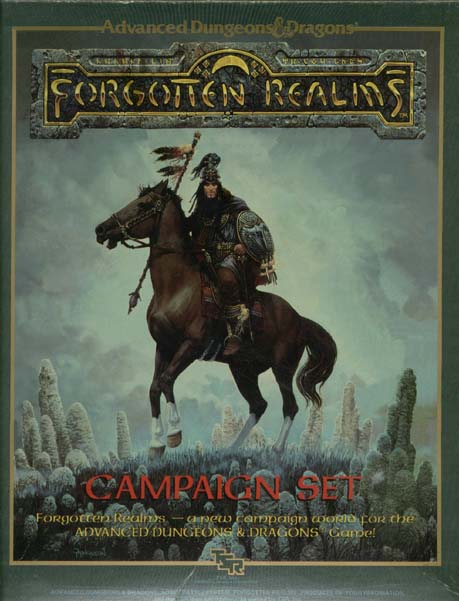
Setting Review: The Forgotten Realms

Following on  from my Setting Map review series and my more recent thoughts on 4e's Nentir Vale and Dragonlance as a coming-of-age sandbox, I've decided to start a review series of published settings overall. Mostly D&D, but we'll be delving into some 3rd party settings, Warhammer and a few others.

These reviews will be personal and mostly aimed at giving the reader an impression of the flavor, style and gameability of the setting.

I am starting with the setting that has probably the greatest exposure of all.

The forgotten realms! Everyone knows it, or knows of it, at least.

Quick intro to the setting

(See also my review of the map of the forgotten realms)
Let's start by showing the realms from its most flattering side. Quote Ed Greenwood, from the old 'gray box':

"Most of the area under discussion here has until recently been covered by wild forests and unsettled grasslands. Civilization is still a novelty in much of this world, even the oldest of cities on the Inland Sea, or the founding of Waterdeep, the greatest City of the North, are within the memory of the oldest living elves of Evermeet."

"City-states are common, and nations on the increase as more of the wild lands are pushed back and gathered under a single king or government."

"Finally, the Realms are a land of adventure, and therefore adventurers. It is the time of heroes, when one man of pure heart (or with a powerful artifact) may hold his own against enemy hordes, where legions of evil forces may muster and be destroyed by the actions of a few, where the nations rise and fall on magical tides which mere men can control."
In a nutshell, a sword & sorcery setting for exploration, where human civilization is still in its seedling stage - A quick look at the main adventuring areas gives us an outlook like this:

The Dalelands - Sure, they are clichéed by now, but smatterings of peaceful little rural communities separated by deep woods where monsters and ruins abound amidst abandoned elven realms is quite frankly an awesome sandbox to start a campaign in.

And frankly, when you sit in your dale and look around, each direction is just a promise of even more adventure:

Cross a small sea to the east to go exploring in a wild west land of independent city-states in The Vast.

Go west to Cormyr to adventure in classical kingdom-with-knights-land.

Or north for some darker adventures in the Moonsea.

Go even further west, and the Western Heartlands open up a vast wilderland of scattered towns, secret elven kingdoms, ruins and exploration. Same with The North, only more desolate.

And further east and south, beyond the Vast, lie decadent deteriorating city-state,  distant forest realms ruled by sorcery queens, desert kingdoms, dark magocracies, witch lands and utterly ancient empires ruled by god-kings.

What are the realms like?

In its briefest summation, the Forgotten Realms is a Tolkienesque setting that, with the fall of Myth Drannor, became a roughshod Sword & Sorcery setting. And unapologetically vanilla kitchen-sink fantasy.

Moreso than the settings that came before (including Greyhawk), the realms embodies the implied setting of D&D. 

By implied setting, I don't mean what grognards extract from pouring over every paragraph of the original publications, but from what fresh gamers imagine they will be doing when they start on D&D: Travelling through enchanted woodlands, meeting archwizards and sorcery queens, engaging with noble elves and encountering dwarven kingdoms, exploring ancient ruins and uncovering lost secrets in a land of forgotten glories. Whilst unceremoniously lobbing fireballs and enriching yourself with the stuff from the critters you just killed. 

Basically, some diffuse mashup of Tolkien (Elves, dwarves, Dalelands), Medievalism (Cormyr), Sword & Sorcery (all over the place), some ill-defined American frontier mentality of exploration (western heartlands, the north) and on the edges of the known world - A barrel full of the truly exotic and weird that far away fantastical lands should have (beyond the heartlands).

For comparison, I think this mix is what has made the realms more appealing than Greyhawk which is often seen as bland. The Tolkien influences are less clear there and all the realms of men are, by design, wholly mundane (since, in Greyhawk, the encounter with the Weird and fantastical happens when crossing into the wilderness) - So no sorcery queens, godkings or other weird stuff that people see themselves meeting when playing D&D. The Forgotten Realms have all of it, albeit often at the edges of the known world (by the time of 3e, that edge was erased and you could totally have a group with an aasimar cleric, a genasi sorcerer, a dragonborn paladin and a drow ranger - just from the core setting book).

Things I don't like about the realms


Let's start with the first criticism that is true no matter what iteration you use:

It's a Set Piece Setting

The realms may be primed for adventure, but it does feel a little too gamist.

I am not asking for Harn level of 'realism', but there is no sense whatsoever of how the current culture(s) of the realms arose.

Why are there knights and nobles? Because knights and nobles.

For contrast, the World of Greyhawk doesn't give us details of how these arose, but they are easy to infer from the history and style of the setting. It's easy to picture farmers toiling in the soil in the Flanaess.

In the Realms, it's probably best to not look to closely at them, lest you discover they are just decorative props placed on the way to the next dungeon. It just feels a bit too much like a set piece for D&D adventures than a living breathing world.

The disjointed history of it doesn't help - It's basically a story of "...then this kickass empire did kickass things and left dungeons and artifacts behind before KABOOM. And then the next empire did the same, but with different artifacts..." - Which is a fine element to have. But nothing in it really tells us how the current realms came to be.

The Dalelands and Cormyr for example, are supposed to be these plucky up-and-coming realms nestled in the ruins of former majesties. But both are comparatively ancient to most other realms around (1200 years+) - Effectively making them weird for just having hung around for a 1000 years without any real development or change happening, with no real sense of  where these people came from or how their culture developed.

They could have made a lot more sense as human successor states arising in the wake of the fall of Myth Drannor, for example (which was still over 500 years ago - a very long time in medieval terms). Both in terms of age and development, but also in terms of telling us what they grew out of. Humanity as a fledgling culture developing on the borrowed remnants of their former elven patron empire. Alas, they basically seem to have popped from a vacuum and stayed that way for 1200 years.

Now for the second point of criticism

Bullshit in later editions -  NPCs, novels, metaplot & canon

Most grognards favour the original gray box whilst latter generations tend to hail the 3rd edition book as a masterpiece of setting work.
For me, I prefer the 2nd edition boxed set, minus the Times of Troubles shenanigans. In fact, setting the startdate a decade or two before the original startdate still gets you all the best of the realms without the added junk (including Greenwood's own - Why would I go to the haunted halls of eveningstar when the knights of myth drannor already looted the place?). 
The 1st edition set is just a tad too incoherent in its presentation to work for me. And that 3rd edition, while it did a masterful job of condensing a truckload of usable information into one tome, just made the realms seem too small and too busy. The Shining South was no longer a far away land of magic shrouded in myth - It was just another step on the trading route of known lands. Sense of wonder? lost.

Basically, the problem with the realms is everything that happened once the wheels started turning. Novels began being written and become 'canon'. Drizzt made good drow rangers cool. GreenwoodElminster bangs a high-level hot chick and goes and does some canon bullshit somewhere else. Harpers foil a plot from pantomime Zhentarim villains, etc. The time of troubles crapped on everyone's ongoing campaign (though it did hilariously spawn The worst module series ever), shadow wizards start invading the realm in other novels, bla bla bla. By the time we hit late 3rd edition, I didn't even want to know what was going on anymore. It's more marvel-universe-in-fantasy-dressing than whatever it used to be.
Then 4e came along and basically trolled the Realms into extinction. 5e  tried a soft reset by advancing the timeline enough to make the far future a bit more like the good old days. whatever. Take me back to 1340 DR please. 

Conclusion

Basically, Forgotten Realms is an evocative setting that fits D&D assumptions like a glove and works eminently for gaming -  It is however, also a hot mess, greatly encumbered by decades of being a shared world. With a bit of discipline, this can be shaved off for a perfectly good D&D setting, if immersion is not too important.

Recommended point of entry? Get the 1st or 2nd edition boxed set, read the setting and imagine it 10-20 years early than the set presents, somewhere just before Greenwood's own groups started running the realms. Maybe read the first few sourcebooks released for it. Get the setting from that. If you need more, you have a wealth of material to choose from, but treat it like salt - A bit added can enhance the flavour. Overdose and you'll ruin an otherwise perfectly good meal.

Thursday, August 3, 2017

Dragonlance was a Unique Sandbox

Dragonlance has a bad rep in some old school circles. For me, it has always been one of my favourite settings. It certainly has its flaws, but it had a brand of fantasy that mixed coming-of-age stories,  faerie tales,  romantic sagas and plain D&D in a way that spoke very viscerally to my sense of wonder and... well, fantasy. The novels helped create a sense of immersion and of an intertwined and living world with its own mysteries and concerns.

Not the Chronicles/Legends (or their spinoff railroads) mind, though I read and enjoyed them (they now figure prominently on my 'not sure I want to ruin childhood/teen memories by re-reading in my 30s' list). That story was too big really to be about anything other than the heroes it featured. It was never really what Dragonlance as a world was about for me. It was all the other ones, the small tales, that grabbed me and pulled me deeper into the setting.

And of course Tales of the Lance, the boxed set:
Some people hate the Elmore quality of this - I love it
As a kid, this set was my most treasured tome, to be poured over countless times and always returned to after exploring other things. For several years, there was one section I always ignored as uninteresting though: "Using the Adventure map and Talis".

I've blogged before on how the setting map in Tales of the Lance has loads of adventure potential. If you flip it over, you get a hex map of Solace and its surroundings:

What's the deal with the "story track" section? It was never explained anywhere.
Once I  actually paid attention to this section, I realised I had been ignoring the most gameable part of the book. I didn't have the concepts for it back then, but this section presented a wholly traditional sandbox, complete with terrain types, interesting locales (each entry with a mood, likely reaction, move cost, chance of getting lost and chance of events), index-cards for a variety of NPCs (also work for PCs for quick-start if needed) and the hex map above. Looking at this today, this was made by a seasoned sandboxer. It has all the info you want to run one well. In fact, I don't think I've ever seen any TSR product present such a well-structured and easy-to-run sandbox as this one!

It is not quite an 'old school' sandbox though, in that it has some unique features - The hex map is intended to be shared with the players at the table (it also doubles as a battlemap). And not only do they have a clear overview of the landscape, it also reveals the location of all the sites of interest and provides detailed maps of several of the sites!

It makes it very easy for beginners to get into this style of play - Take a look around the map, what looks cool? What would we like to explore next? It gives players a lot more to go on than a blank hex map they have to fill out themselves. Actually, it's a format I'd consider using myself.

It also makes a lot of sense, in-game, for the genre it wants to sandbox. This is not a game of exploration of an unknown borderland frontier for gold and glory. It's a game of coming-of-age exploration of the many adventure sites to be found in the vicinity of a backwater town, in the style of the excellent Beyond the Wall and Other Adventures OSR game. It is to be expected that the PCs would know what's on the map from growing up in the town and hearing the local folklore and legends about these places. This is not about exploring the unknown as much a it is exploring the history, folklore and mythic fabric of their home community. Sandbox-style.

It is certainly a different genre to old school D&D. But Dragonlance didn't just 'ruin everything' with railroad modules. Though hardly noticed (did anyone actually use this sandbox?), it gave a unique and very well executed take (ok,the talis cards were a bit weird) on how to use the sandbox format for completely different genres.

Besides the actual hexmap and sandbox chapter, the setting map littered with terse adventure sites, here's some more proof that the authors of Tales of the Lance very much intended their product to be used in an open-ended explorative sandbox format. Take a look at this section of the DM screen that came with the box:

Whoever made this, wanted to use it for sandbox gaming.
The back of the world book is a frigging random encounter chart and we also get to large maps which is just a bunch of adventure locations with no descriptions. Go crazy.

I always felt Dragonlance before the war was a great setting for gaming - If I were to run it today, I'd run it in that period, with a clearly stated premise that there was not going to be a War of the Lance on the horizon. No dragonarmies, no world in need of saving, no heroes of the lance. It is however, a world at the dawn of a new age. The rousing of the world from the cataclysm would be a more gradual one, and the conflicts erupting, though reflective of a wider dawning of a new age, more local in scope.

The year is 340 AC, the latest news in the town of Solace are gloomy as a ragtag band of local adventurers, including the local dwarven blacksmith, were all killed on their latest quest.

Clerics have begun to resurface in pockets across Ansalon, but they are far and few in between and far from everyone believe that the old gods have actually returned. A PC cleric would be rare and controversial, but hardly unique.

Dragons have been sighted across ansalon in recent years as well. Not enough to convince most people that they are anything other than stories from a former age. But sighted nevertheless. tales of obscure 'Draconians' are also emerging.

I'd run them through the local sandbox at low levels, then begin to introduce some more regional threats. An evil priest of takhisis has allegedly allied with a red dragon and occupied an old dwarven fortress and using it as a base for invasions into Abanasinia. This is what rams home that a new age is dawning and that both the gods and dragons are well and truly back. Play it by ear from there, steal various plot hooks from later developments, but make them more local.

Maybe I'd use Beyond the Wall to run it. But actually I've felt for a while that 5e was more suited to dragonlance than any other edition.