Thursday, August 18, 2016

Meditations on the right D&D system - how to choose?

I have recently felt a yearning to settle on a proper system as a lens to express and think D&D through.

The ones that are floating through my mind are B/X, Swords & Wizardry, 5e, DCC and Fantastic Heroes & Witchery.

For pure nostalgia, B/X is the one. And also why I am not feeling it for Labyrinth Lord. I don't really see what it is supposed to offer as a new iteration of BECMI when simplicity+nostalgia is a driving force? Less nostalgia and with little better solutions to make up for it that I can tell.

5th edition is the easy choice. It is modern, streamlined, easy to run. But its strength is also its weakness. It is so very tight and balanced - meaning every tinkering has a consequence (although far less than 3.5 or 4e). This sort of system also creates an expectation of balance, 'fair progression' etc. These may be valid concerns, but I'd like a system that flips players into a world where these concerns are trivial. This concern is contradictory to my concerns about retroclones I will address below.
5th edition also has the advantage of being our current system. And my group is hard to change. Funny enough, 5e's simplicity compared to 3.5 has shown my group that stuff like feats and such aren't really that important. I think convicing them to go even simpler could be doable.

Swords & Wizardry has appeal as a simple and streamlined system. And highly modular when you want extra complexity which is a big plus. And it has a small feature I wish it had more of - modern mechanics in the name of simplicity - its save mechanic and offering an ascending AC.

This alone could be enough to make me jump in, but to be honest, I want more of it. I love the idea of whitebox - simplest chassis possible, with just a few modern mechanics to simplify further and all the room in the world for the modular extensions you need and no more.

I just wish for a system willing to go even a bit further with modern mechanics that simplify. OD&D still has quirks that create toil that comes across as unnecessary from a modern perspective. XP bonus for prime requisites, gold for xp, the Thief as a whole, etc.

DCC is high on my list as something built on the same chassis, with modern mechanics on top - the fact that these mechanics are specifically servicing a pretty awesome genre and style of play is an extra plus. But it does seem to me that it goes a bit too far and is not quite so well executed at times. DCC 2nd edition I would play without hesitation.

Fantastic Heroes & Witchery, despite having plenty of bloat and poor organisation, appeals to me for its unabashed D&D-how-it-should-have-been quality and attitude of "can do" whenever you want something more than the basic approach. Racial classes (as opposed to race-as-class) is brilliant and should  be standard all across the D&D-sphere. And it is unabashed in taking in modern mechanics where they are simple and make sense - multiclass, xp progression, ascending AC, unified saves, streamlined attribute modifiers.

Conclusion:

FH&W and DCC seem like the best bets for Old School games that could also pass a litmus test of modern sensibilities for simple and balanced mechanics that don't try to reinvent the wheel.

Basically, if FH&W was organised differently, I'd run it, swear by it and disavow all else. But dumping a 425 page manual on the table does not convey "it'll be simple. don't worry." And the organisation of it is a bit of a mess as well, with classess spread throughout the book and such. I love that it wants to do so much, but it makes it a hard sell. I long for a more modular  FH&W.

My dream version of FH&W is a boxed set with booklets. One for character generation, one for spells and magic, one for rules in general, a Science-fantasy booklet, a Monsters booklet and a DMG booklet. This I could sell to my group with ease.

Alas, the next-best thing is probably DCC. Also an enormous book, but far more coherently laid out. The entry requirements are not steep - Maybe  FH&W is not either, but it does give an impression of being so (and these matter, unfortunately). I could probably sell this and we'd have loads fun. Even though secretly, I'd be wishing we were playing FH&W.

Monday, August 1, 2016

Fixing the Cleric? Make Sense of the Cleric

Googling "Fixing the Cleric" in quotes give ca 17900 results. Obviously, this is a recurring theme of frustration among D&Ders. So here is take 17901 trying to do the same.

Why this keeps coming up is not hard to see - There are no clerics in fiction. It doesn't match to any sort of narrative archetype. The only archetypes it is recognised as is gamist: "the healer". As it is, it falls squarely between the two stools of religious warrior (which is the Paladin) and Mystic (which doesn't really exist in D&D).

It's not that divine classes themselves struggle with this. Paladins are an easily recognisable archetype, as are druids. Yet, somehow clerics seem to expertly evade narrative recognition after decades of being a core class in D&D.


The Cleric as Gamist Archetype


Maybe if they had made the cleric more like the monk, using simple weapons and little armor but being somewhat capable in melee anyway and then jazzed that up with clerical power, it could have fit in as a martialised monkish mystic type. Shaolin monks is a recognisable archetype. Friar Tuck with spellpower would have been a recognisable archetype too. I am frankly amazed that D&D never went this route but instead have persevered with this gamist cocktail of 'heal/turn undead and other assorted things'. Clerics are basically fixers of all the gaps in the others classes.

It is tempting to make a class like this. I might at some point. I think it'd be much easier for players to grog. Nonetheless, since one of the design goals of Erce is to be inclusive of D&D tropes, it should be able to make sense of the cleric we all know and tolerate. In other words, finding the narrative niche of the Cleric and establishing what archetype(s) the cleric could be. Finding out how a cleric would make sense in fiction the way it makes sense as a gamist 'fixer'.

Actually, though often overlooked, the Cleric is not just a mix match of a abilities a group needs that other classes don't have. It fills a clearly defined niche that most gamers tend to look elsewhere for: The Gish.

Full spellcasting power - Check. Martial Ability - Check. Assorted abilities to more than just fighter/wizard - Check. No doubt about it - Clerics are easily the most well-designed gish in the history of D&D, welcome at any gaming table.

With that in mind, we can try and ask what kind of archetypes match that. One very recognisable one comes to mind: The Jedi Knight.

Aleena if she had levelled up to become a Jedi style champion

The Cleric as Mystical [Jedi] Champion

He fearlessly strolls into combat with a melee weapon. But really, he is more about the supernatural powers he brings to combat. And out of combat, he's about the mystical powers and bend wedded to a specific philosophy that demands more of him than his fellow men. Was that a Cleric or Jedi I just described? Same niche really.

Though from science fiction, the Jedi is a mythic type of hero that can easily be put in leather armor and runes and fit into fantasy fiction. And in fact, has parallels in Sword & Sorcery fantasy too.

Don't think Friar Tuck or Archbishop Turpin when making a cleric - Think Elric of Melniborne and similar Moorcockian Champions, albeit a bit less unique.

For OD&D, where you are a cleric of Law or Chaos moreso than a god, making clerics the Jedi of D&D is a very simple fit really. This is basically how Law/Chaos clerics ought to have been envisioned from the outset - As mystical champions of a metaphysical cause.

Since Erce is already heavily embedded with Law and Chaos as a defining paradigm, this is an easy insert really. Clerics are Law Jedis. Straight up. No alterations needed.

But what about gods? Making sense of the cleric requires making sense of them as clerics of gods since really, this is what players think of for a divine class.

The Champion & The Sponsor


One way to do this whilst still retaining the clerical role of Mystical Champion is to make gods akin to sponsors on behalf of Law/Chaos moreso than the source of power itself. In Erce, it would look something like this:

All clerics have a divine patron. Or several. They receive their power not directly from the god, but through the god. When bonding with a deity to become a champion of Law or Chaos, your divine patron(s) is like a conduit - A prism through which Law is apprehended and drawn from. A cleric of course has a relationship with his god. And his views on the metaphysical cause he champions is no doubt shaped by it. But ultimately, he is beholden to their common cause and not the deity itself.

This take on the cleric also adds another crucial dimension for gaming: Agency. For me, it has always been iffy to navigate the waters between 'what I think my player should do' and serving the will of your god. Ie 'what the DM thinks my player should do' - And no one really wants to serve the DM. With this setup, which is really more collaborative (gods champion and represent Law on a cosmic scale, Clerics on an earthly scale) Clerics are left free to interpret their cause according to their own convictions, as their relationship with the god is really more of a case of mutual benefit and common conviction (although of course, the god may end up withdrawing sponsorship if it sees too little benefit and common cause).

Though of course, there is room for a range of relationships. Igor of Lugin is something of a puzzle to his clerical peers due to his frequent blasphemies and the blatant disregard he pronounces against his patron in public, yet somehow Lugin continues to sponsor him. He must be doing something right in the eyes of his god.

Conversely, Oragon of Etreos is ridiculed, even reviled, by his peers for being such a snivelling lap dog to his patron. His nickname is "the errand boy" and it is said he doesn't even relieve himself without prior approval from Etreos.

Religious disputes then, are more philosophical in nature - Which god(s) most accurately, or most efficiently, reflects and embodies the cause of Law (or other cosmic principle(s) you may have)?

How the Cleric becomes a cleric


Another question that somehow has never been been properly answered is: How does a cleric become a cleric? Answering this tells a big part of what kind of role they play in the setting. D&D seems to imply that it is really just a question of devotion and faith. A dull answer that paves the road for any local devotee to start turning undead and consequently make clerics equally dull. Where there is faith there are clerics basically. How utterly droll and not special. No. Some NPC class should fill that droll niche. Clerics are heroes. Champions. Their origin needs to reflect it.

No one becomes a cleric. You can't go to sunday cleric school and become a cleric by simply applying yourself with real devotion and faith. That's wizards, those ungodly nerds who are essentially just metaphysical mathematicians. No. Clerics are chosen.

The gods are always looking for the right candidates to sponsor. They can't just willy nilly sponsor someone, because to sponsor a cleric in the mortal realm is to give up part of its own power in the cosmic realm. Being gods, they spend a fair bit of time looking into possible futures to find the right candidates - Making sure the candidate will give them highest possible chance of a good return on their investment.

Clerics are chosen for sponsorship by their patrons before they were even born.

They are the childhood freaks who spontaneously casts sacred flame on the local bully without even knowing they could. Who worry their parents with their visionary dreams that has them waking up screaming at night. And all the downright strange portents that keep happening around him that only a skilled oracle would correctly determine as having the favour of a certain god. The patron god is an inescapable presence in the life of a cleric-to-be.

Clerics who deny the fate chosen for them seldom live happy lives. Freak accidents (which again, an Oracle could tell you the reason for), visionary nightmares and a general sense of life being somehow just off tends to be the outcome. The morale is clear: Only when you embrace your destiny and  become a champion of the cause, a cleric, will your life become meaningful.

The act of actually becoming a cleric always happens face to face - When the cleric-to-be is ready to embrace his fate, the sponsoring deity sends an avatar of some form (usually in a temple where it is easier for them to manifest) to perform an empowerment that creates a bonding between cleric and deity - the conduit through which the cleric is imbued as a champion of Law. Thus, all clerics have personally encountered their patron god in the flesh at least once in their life.

Ironically, though I talked above about how Sponsored Clerics of a Cause have more agency in interpreting their cause than mere god worshipping clerics, they had much less choice in choosing their sponsor and cause in life in the first place. Those dice were rolled before they were born.

Clerics & the Religious Establishment


For similar reason, Clerics are not especially well integrated into the religious establishments. Since neither religious training nor education is a requirement, clerics often have a proclivity for the unconventional, even blasphemous, to the eye of the uninitiated. Likewise, the religious establishment is uneasy with the direct nature of the relationship clerics have with their god. The unlearned might start to think clerics speak directly on behalf of the gods even when it contradicts orthodoxy. Nevermind the fact that some do speak for their sponsoring gods (for 9th+ level clerics, casting Commune and Divination as rituals basically constitutes your daily meditative practise).

When the religious establishments recognise a cleric they generally tend to try sponsor them. As the gods sponsors clerics in cosmic matters, so the temple sponsors them in earthly matters. Which is to say, attempt to assimilate them, train them and indoctrinate them into following their orthodoxy (or with a kinder spin: Give them opportunity to maximise their potential and make use the establishment to advance the will of the deity). For local temples, there is also some measure of prestige in having a cleric sponsored by that specific temple - That said, it is often an uneasy process, given the nature of how clerics are chosen.

Some are chosen who have natural affiliation with orthodoxy, relish the opportunity and enrich temple life with their engagement. Others are chosen exactly because they will never be orthodox and can accomplish things the temple would never consider. For others still, the tug and pull of the establishment is just one of those things in life to be endured between working on what's really important.

From the perspective of the establishment, managing clerics is often likened to herding cats. Although their merit is acknowledged, their means are a frequent source of frustration. Though rare, it is been known to happen that some clerics have been assassinated by their own temple due to the complete disalignment between the cleric and the temple's outlook.

Changing patrons


Above, I mentioned how gods invest some of their own power into a cleric when sponsoring him. This investment also gives the cleric some leeway in his actions - A god can sever their bond, basically removing all clerical powers. But in doing so, they permanently lose the portion of their power they have invested in the cleric. Such a thing is not done unless the cleric is becoming a major force for heresy in his god's name.

Such 'severed' clerics are prime candidates to be adopted by other patrons whose affiliations may lie closer to the path the cleric has now gone down, since their bodies and minds are already highly moulded to channel and shape the mystic power of Law/Chaos.

Sometimes, the cleric might of his own volition seek to have his patronage transferred to another god, whereby the cleric relinquishes the power of his patron, sending it back to the diety in question, so he can be imbued with the patronage of a new god. Depending on the sponsoring god so abandoned, this may or may not be a cordial affair.

Clerics in Erce


The Old Gods care little for piety or worship, and are more inclined to acknowledge sacrifices, gestures of respect and bargains. Clerical bonding is less holy affair and more pragmatic partnership between god and his earthly champion.

Unlike the Old Gods, The Nine Gods of the New Order have formed an orthodoxy  that encourage frequent prayer and temple worship, harnessing this to shelter humanity in the Divine Dominions. They demonstrate a conviction that each represent facets of Law, but that the Nine as a whole are a perfect representation of Law.
Essentially, clerics of the Nine take all Nine as their sponsoring patrons, though they may be closer to one or two than the others (domain choice).

Where the Nine represent aspects of Law, The Triune Goddess of the Hearthstone Church holds that true Law is a Unity - Which the White Goddess not only represents, but is. And furthermore, that Law is a principle, a light, that can be directly cognised and embodied the same way the Triune White Goddess embodies Law - Essentially, the path of the Triune Goddess transcends itself for its most accomplished champions who themselves becoming living embodiments of the Light of the Law. For patron and champion alike, their relationship culminates in selfless symbiosis and unity.

Clerics of Law in Erce then, are sets of exclusive mystical fraternities for the select few - Chosen Champions of Law. They certainly differ on how to understand Law - Wars have been fought over these disagreements.

The Old Faith is seen by clerics of the Nine and the White Goddess as hardly champions at all - more akin to warlocks who make pacts with otherworldly beings to further their own ends.

Clerics of the New Order are seen by the Old Faith as saddled by doctrines and subservience. And by Hearthstone clerics as holding to a fragmentary understanding of Law that is sadly incomplete in matters of ethics and spiritual transcendence.

Clerics of the Hearthstone Church are seen by the Old Faith and the New Order alike as almost ungodly. The notion of Unity with the Light of Law is unnerving and paradoxical to them both in the sense of seemingly bypassing your divine sponsor to channel Law directly (which, 'everyone knows', is impossible) and in the sense of becoming one with one's deity, essentially surrendering personal will.

Yet there is a kinship between clerics that sets them apart from normal society. All of them know they channel the same mystic power as Champions of Law. Though they may disagree on the form this cause takes, it is ultimately a common cause. And all of them know they are chosen by cosmic beings for this task for a reason. They are going to make a difference in the world.

As for clerics of Chaos - The less said the better. These vile creatures who give up their bodies and souls for personal power, betraying humanity to demonic princes and devil lords - No, not another word shall be spoken about these dark champions.

(Revised on 01/08)

Friday, July 29, 2016

Adventures in Middle Earth for D&D 5e pre-ordered

I just Pre-ordered Adventures in Middle-earth Player's Guide and Loremaster's Guide from Cubicle 7. Probably the first pre-order I've ever done as I normally like to wait for reviews. I am dead excited about this one. I bought The Heart of the Wild from them, knowing I would likely never play it, just to see their take on this type of area as a gaming setting - and loved it.


I have admired the craftmanship of ToR for a while, but also know that my gaming group dislikes spending time on learning a new system and convincing them to switch would be next to impossible.

Adventures in Middle Earth not only allows me to pitch a "Middle Earth Done Right" campaign with 5e - But from looking at their FAQ, it seems they plan on re-tooling classes and backgrounds to suit Middle Earth. Presumably making them much less overt and more setting-grounded flavourful than the 'sling fireball / epic smite'  style of D&D.

I am also eagerly anticipating what promises to be the the most qualified re-tooling of D&D for low-fantasy genre made, with a view for swiping it for my own low fantasy campaigns. Proper 5e support for this genre would be fantastic.

Now all I need is for  Flatland Games to re-tool Beyond the Wall and Other Adventures as a 5e enhancement supplement and all my subtle-power/high-flavour needs shall forever be satisfied.

Sunday, May 29, 2016

Humanoids, Part I: Giving Humanoids a Raison d'ĂȘtre

Another issue frequently blogged about in the D&D and OSR blogosphere is the neverending variety of humanoids in D&D and their vague distinctions.

Goblins,hobgoblins,bugbears,orcs,gnolls,kobolds,orogs,etc. It seems Gygax basically made a critter for each minor increment of hit dice - Their differing roles otherwise being trivial.

I've struggled myself with this as well - What really distinguishes orcs from hobgoblins? What is the point of having kobolds and goblins?

I think I have landed at what I feel is satisfactory writeup for the various humanoids that makes them distinct and gives me a reason to have them in the world.

Partly because I've identified what I think is one of the main issues with the various humanoids - It is never clearly defined how they relate differently to humanity.

I found that once I started thinking about these races having a history and then focusing on their ecology as they impact humanity, gave me inspiration to start writing. Without further ado, in descending order of the "Threats to Humanity" scale:

Beastmen


Beastmen cover a variety of humanoids. Gnolls, Broo, Minotaurs, Harpies, Boar Men, Ratmen, Kobolds are just among the most notorious. Common to all of species of Beastmen is that they came into being little more than 1500 years ago, when Nydecia, the Empire of Man, was at its height - With the loosening of the Beastman Plague - Think 28 days later, except that people mutated into all kinds of mutated crosses between man and beast - And all of them infected with a  blood-crazed madness and hunger for slaughter and flesh. The heartlands of the empire kept them at bay, but civilization fell apart pretty much everywhere else. 

Eventually, some Big Damn Heroes went on a quest to quell the plague - The contagion became less and those infected did not become full beastmen except in the full moon (and so Lycanthropy was born) - Those already infected had their madness slightly lessened and began to breed true. But their nature was irrevocably altered - The beastmen races would remain minions of Chaos and roam the lands of devastation they had wrought freely for centuries more. 

Today, when humanity has won back much of what was lost in those dark years, Beastmen remain one of the biggest threats to civilization, raping and pillaging villages and towns with abandon and little thought for their own survival. The thrill of killing, raping and eating of flesh continues to drive Beast-men. Though they tend to congregate according to their kin, it is common for stray beast-men of different types to join with other beast-men. Broos and Gnolls are the most common types, but most humans tend to lump them all together as simply "beast men".

Every so often, an evil wizard discovers the spells for loosening new beastman plagues. Though, unlike the original version, the contagion is of limited duration and is preventable with clerical magic, they still last long enough to devastate entire countrysides and replenish the hordes of beastmen even further.

Due to their origin as creatures of chaos magic, beast-men are especially susceptible to summoning and charm spells, making them easy picks as minions of evil wizards. Beast-men in fact desire such subjugation - Being under the effect of such charm spells weakens their ravenous appetites and gives them a small taste of their lost humanity.  Woe betide the wizard who brings such creatures under his spell without giving them outlet for their lusts however - Beastmen who go too long without following the dictates of their Chaotic nature inevitably break and end up turning on their masters.

Hobgoblins


The Beastmen themselves weren't the only tragedy of the years of the Beastman Plague. One eastern kingdom, seeking to escape the devastation of its neighbours, made bargains with the Lords of Hell for protection. The devils made good on their promise - The citizens of that now lost kingdom were made immune to the plague and furthermore imbued with unity of purpose and battlefield ferocity to fend of the hordes. In a time were other kingdoms were crumbling, the newly made "Devil-Men" began forging an empire in the east on their ruins of humanity. Ironically, many humans preferred slavery under the devilmen, safe from contagion, to being free in the lands where the Beastman Plague, and the beastmen, still roamed.

When the Beastmen Plague finally subsided, the gods of Man turned their wrath on the godforsaken devilmen, cursing them with skin averse to sunlight and driving them underground. Though this left humanity mostly free of the new "Hobgoblin" dominance, it meant a devastating blow to the Dwarven kingdoms they have never recovered from. Over the next centuries, they would lose the majority of their kingdoms to the new underworld conquerors

Deep in the underworld, the hobgoblins are also found giant reptilians lost in time to domesticate and train for battle.

Yes, hobgoblins ride dinosaurs.
You may now tremble in fear.


There is something unmistakeably infernal about all Hobgoblins - a malice that can not be ignored. Hobgoblins of Erce are in no way savage or primitive. Their devil worshipping kingdoms are highly advanced  and civilized - and as cruel as they are disciplined and ordered. It is truly humanity's good fortune that they have taken their underworld as their home. Were they not burned by sunlight, Erce would surely still be under the thumb of the devilish Hobgoblin armies, rather than  suffering the occasional surface raids and campaigns they do today.

Designer notes: Hobgoblin kingdoms essentially fill a similar role to Drow in other D&D worlds. Except, these are scary ugly rather than scary sexy. And prefer devils and dinosaurs to spiders. And no one has ever heard of a hobgoblin that wasn't infernally evil.

Orcs

Where Hobgoblins are unmistakeably infernal and callous, Orcs are unmistakeably savage and ferocious. Also known as "Sub-men" - Orcs are the closest relatives to humanity of the so-called "savage races".

In the songs and epics of the pre-kingdom tribes handed down to the present (and still ongoing among the barbaric tribes today) are countless stories of the fight for territory and supremacy with the Orcish tribes roaming the same lands, hunting the same game and claiming the same right to ownership.

Today, it seems clear that humanity has won the battle. Where humans have built roads and cities, orcs have been pushed ever deeper into the wilderness, become ever more savage and nomadic and retaliated and plundered human settlements with increasing bestial savagery. 

Though the savage orcs are not the rivals they once were, their existence as nomadic marauders of the wilderness who encroach on humanity whenever they can underlines the fact their ancient nemesis is still one of the major threats to human settlements.

Closing thoughts

I've taken a lump of humanoids here and made them into three different types of threats, meant to evoke different reactions in players when they come up:

Beastmen are akin to an infestation. They are feared the the way deadly disease is feared, invoking fever dreams of madness and dark  desires unleashes. They are a tumour on humanity, a fundamental wrongness in the world.

The Hobgoblins are basically the Dark Enemy. The humanoid nazis threatening to take over the world if good people do not stand against them. They frighten because they are not savage at all - They are ordered, but an order borne of deviltry rather than gods. Unspoken, but nagging in the hearts of men, is rather the fear that the Hobgoblins have become more than humans through their dark pacts with devils.

The Orcs are the primal rival. Imagine bloodthirsty and ferocious neanderthals surviving into the middle ages. Unlike Beast-men and Hobgoblins, Orcs are a natural foe. A savage and primitive reflection of mankind - Consequently, humanity's fight with them is an almost instinctive one of evolutionary supremacy. It helps that they are bestial raiders who continue to attack humanity with mindless abandon. But one gets the sense that even if they were peaceful and gentle, humanity would see them as an enemy to wipe out without really even understanding why.

Common to all three is the notion of a somewhat tragic backstory. 

Beastmen are the victims of a plague, mutated without any choice in the matter into horrid beasts of chaos. The fact that there are still humans today who turn into beastmen makes them an ongoing tragedy.

Hobgoblins were humans who simply wished to not be mutated into such abominations, or raped and killed by them. 

If history had been different, it could perhaps have been the Orcs who built cities and civilisations. Instead, they have become the losers in the evolutionary struggle and have succumbed to savagery, pushed into the wilderness to rage against their inevitable fate, whilst humanity languishes behinds its walls and warm beds.

Next Up

Goblins, kobolds, Bugbears and trolls!

edit: Had to nick this from Allandaros over on rpg.net. Of course Hobgoblins ride dinosaurs!

Sunday, May 1, 2016

Fantasy Map Review VI: Nentir Vale

For links to all instalments in this series, go here.

For the sixth instalment, we visit Nentir Vale, the default setting of 4e. I must admit, I steered well clear of 4e for a long time. But the fluff of it possibly the strongest OSR credentials of any editions. It is eminent and at times simply brilliant.

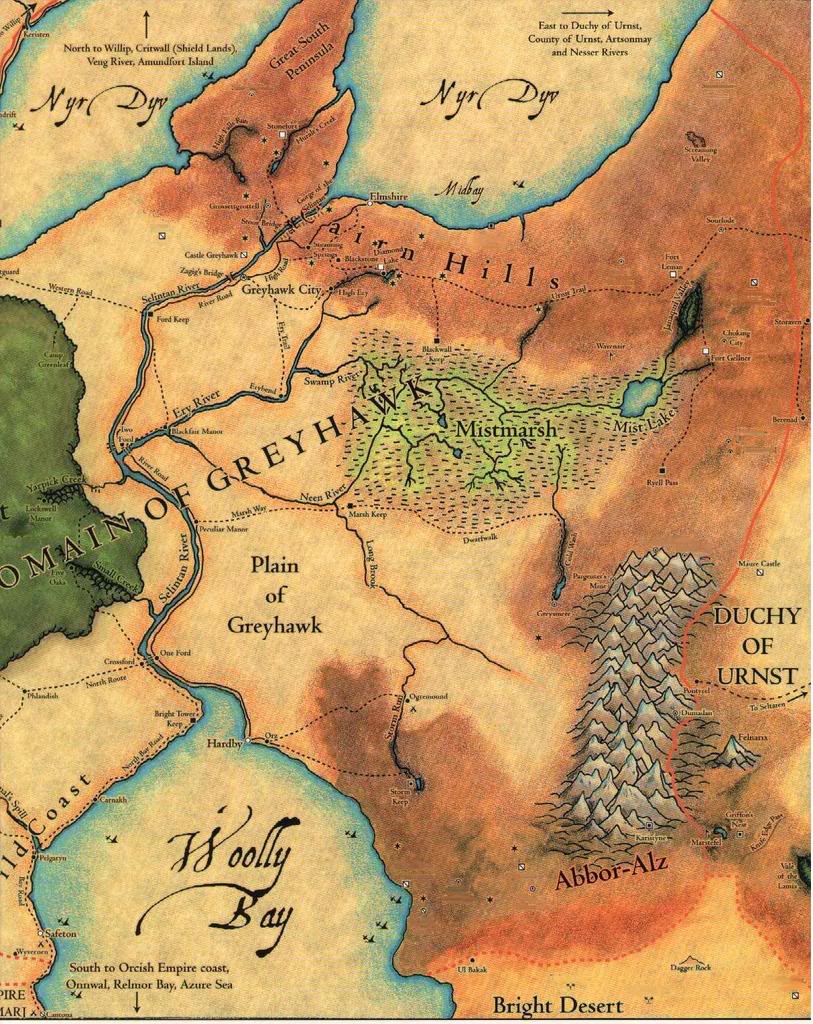
First Impressions: I like it. As a starting DM I feel like this map is much more relate-able than the other maps. This evokes feelings more like the Domain of Greyhawk, where the local campaign asserts its relevance evocatively on the map.

Further Thoughts: In scale, it is more reminiscent of Middle Earth, but, unlike ME, it has a sense of locations that give PCs a sense of the area they are exploring. Although not as flavorful as  ME, it does give a sense of being enough for a local campaign for ant adventurers who aren't too afflicted with wanderlust.

For the far thinking explorer it falls short quickly. But it knows what it wants to be. And, unlike 4e forgotten realms, the artistic requirements are a homerun here. Lovely blend of colours, flavour and contrast. That the red dotted lines are clear yet unobtrusive is a testament to the artistic detail in this map. Lots to explore and delve into for such a small and unambitious setting map.

Style: 5/5
Substance: 2.5/5

The 

Saturday, April 23, 2016

Fantasy Map Review V: Birthright

For links to all instalments in this series, go here.

For the fifth instalment, we come to Cerilia of the Birthright setting. And I move from admiration to love.


First Impressions: I first became aware of birthright when the Birthright Conspectus was included in one of the boxed sets I bought at the time, which included the fullsized map above. It was, simply put, love at first sight. I adored the the woodlands, the mountains, the colour scheme and the stapled borders  - It seemed like a world truly alive. More than anything, it was the map that made me want to know more about this setting.

Further Thoughts: This is is still one of my favourite maps, maybe my alltime favourite. Although the scale of Cerilia is clearly more localised than Faerun or even the Flanaess, the sense of there being plenty of opportunity for exploration and adventure is developed with stunning level of detail instead - Where the Forgotten Realms gives a sense of never running out of new lands across the mountain ranges, this map gives more a sense of each set of hill having new adventure before you even reach the mountain range. And I think I like this setup better for a setting map - It makes the world feel more intimate. In fact, if this map had had a creature/location legend similar to the one in Tales of the Lance, it would be unconquerable for 'greatest of all time' setting map. A map you could run a campaign with, without even needing a setting book.

Where Greyhawk in particular inspired me for how to draw up a setting map in large scale with placing of ocean and such, Birthright sets a different benchmark that I am still struggling to emulate.  It shows how to make a map come alive through loving attention to detail. Less is often more when it comes to setting development, but not when it comes to maps. You can cut out a 3:4 pretty much anywhere on this map, at any scale, and that cutout would be a worthy standalone map on its own.

I have a good deal of appreciation for Birthright itself. It is often criticised for being bog-standard medieval fantasy, but this is what I loved about it - No one else seemed to ever have made proper actual mythic medieval fantasy for D&D - In Birthright, an Arthurian knight can engage in jousting and real-politics before riding into misty mythic woodlands for fantasy adventures. The blend of mundane mediaevalism with the mythic is something it does better than most settings. However, I sometimes find myself studying this map as if it were somewhere else, unknown, and wondering what each little stapled domain is like and what mythic vistas it holds. If I were to run a sandbox based on a pre-generated map, Birthright would be it.

Style: 5/5
Substance: 5/5

Monday, April 18, 2016

Fantasy Map Review IV: Forgotten Realms

For links to all instalments in this series, go here.

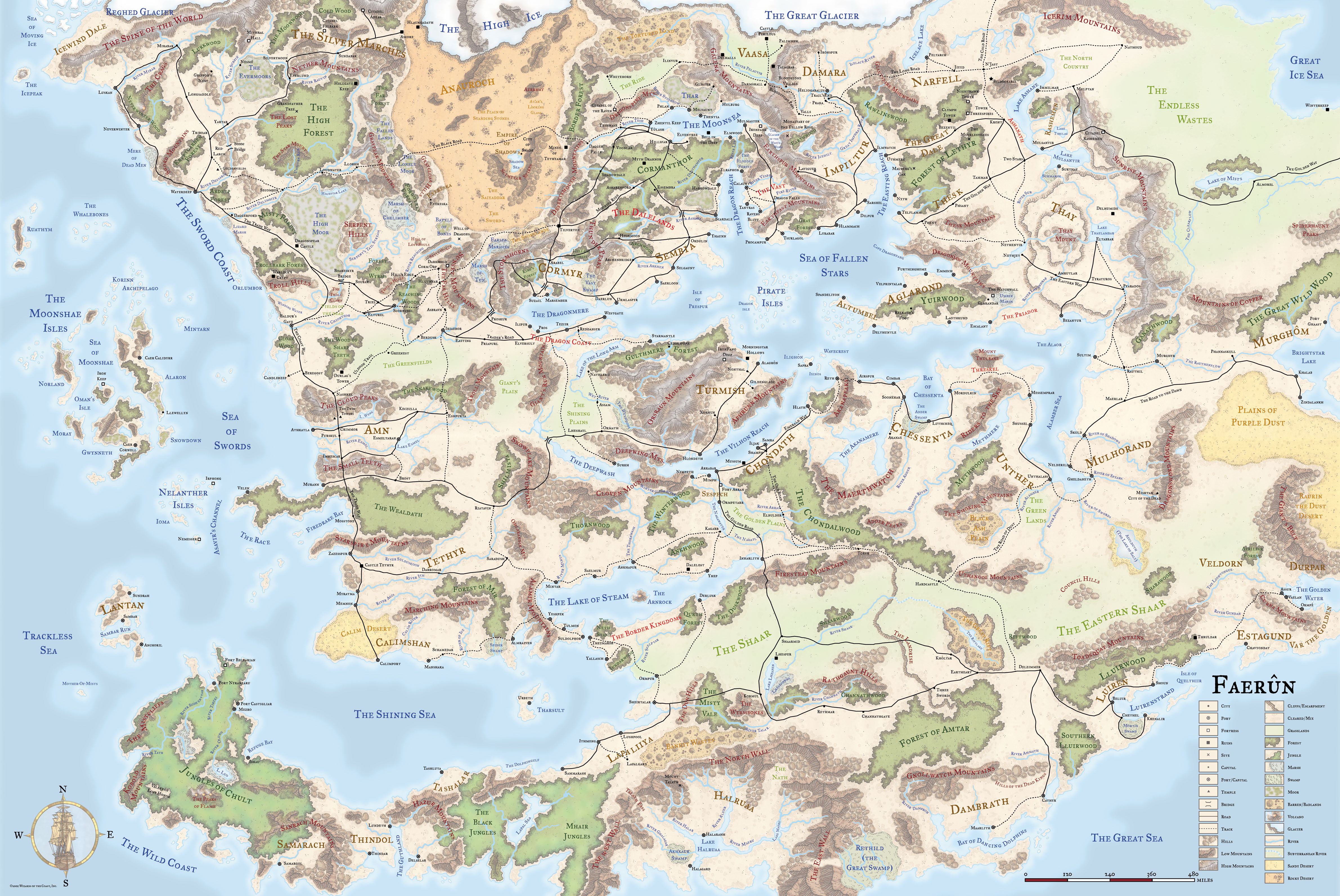
For the fourth instalment is yet another iconic map piece - Faerun. I've gone for the 3rd edition one as that is probably the most widespread one out there and also (imo), the best.


Ed greenwood does a lot of the same things right as Gygax did with his Flanaess map. He understands that placement of seas as separators; points that cultures congregate around; and routes that open up and connects different adventuring areas really makes a difference to a good map.

He nails it with the Sea of Fallen Stars and the multitude of bays, lakes and reaches that feed into it. One boat can set sail in the sea of salt in Mulhorand in the deep south and meet up in the Sea of Fallen Stars with a vessel that started from the tortured lands near the great glacier, passing through Damara, Vaasa and Impiltur before entering the sea proper. Great stuff.

What is really striking about this map is the scale of it. It feels larger than the Flanaess and Ansalon (nevermind diminutive Middle earth) - There is a clear 'centre' in and around the Heartlands (though this is really just the northwestern corner of the map) and from there it seems there is no end to new lands around the next mountain range. Greenwood has done great work to achieve this sense of exploration and making his main adventure area, the Heartlands, sizeable and a setting in its own right, yet just a corner of the actual setting is a great move that not only informs us something about the nature of the heartlands, but tells us the Realms really are endless with opportunity for adventure and exploration.

On an unrelated side note, since this is a map review, this is also what I liked about the 2nd edition boxed set. It managed to convey the sense of distance, myth, rumour and wonder the further you went from the Heartlands. The 3rd edition book, while more coherent and exhaustive, somehow made the Realms feel quite small and explored in comparison.

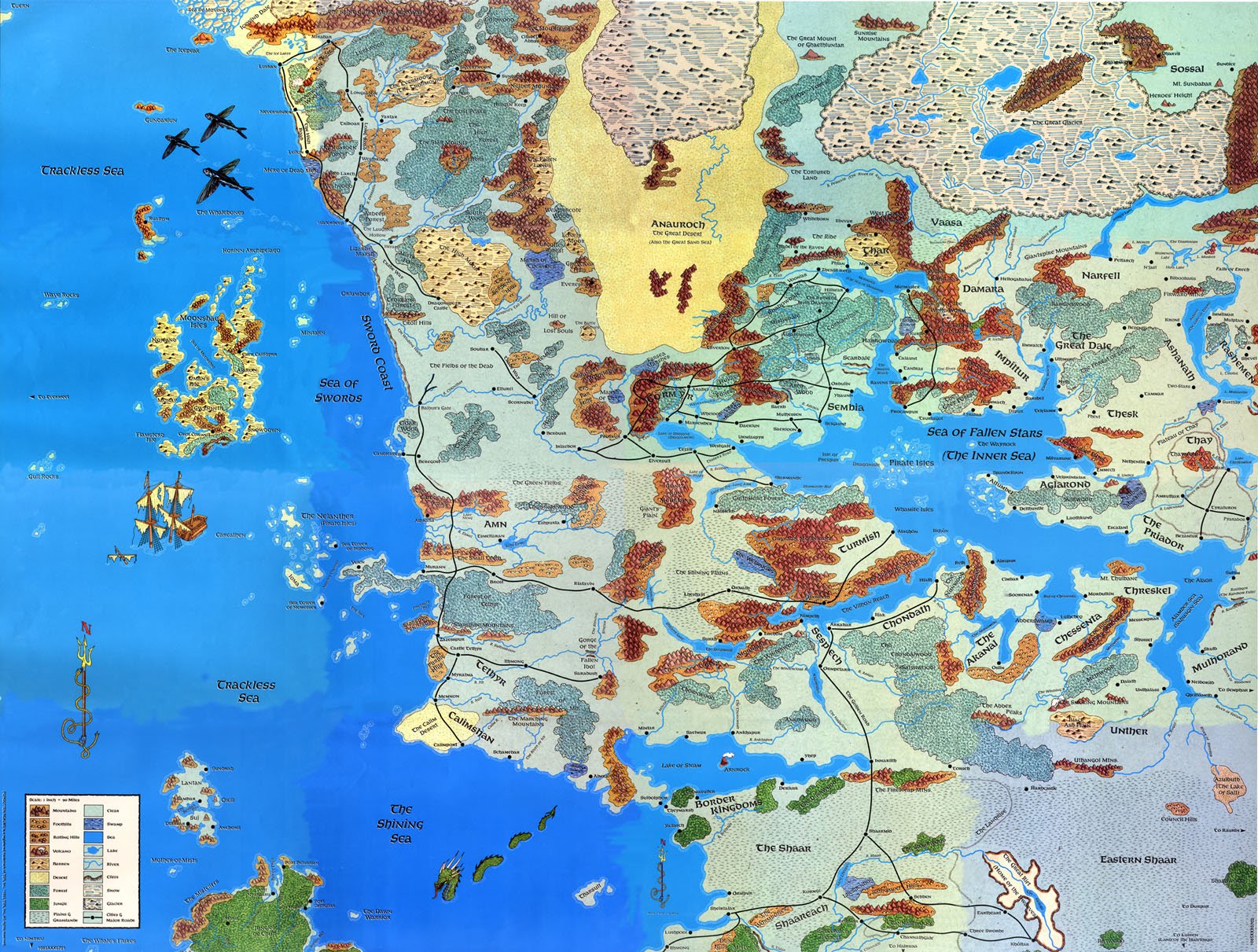
Anyway, back to the map: Artistically, it's not very good. This is true of all editions sadly.  Take a look at the 1st edition map:

Looks like a first draft drawn in MS Paint. No thanks.

2nd edition wins some in terms of stylistic flavour
But the colour compositions is dull and the contrast too sharp.

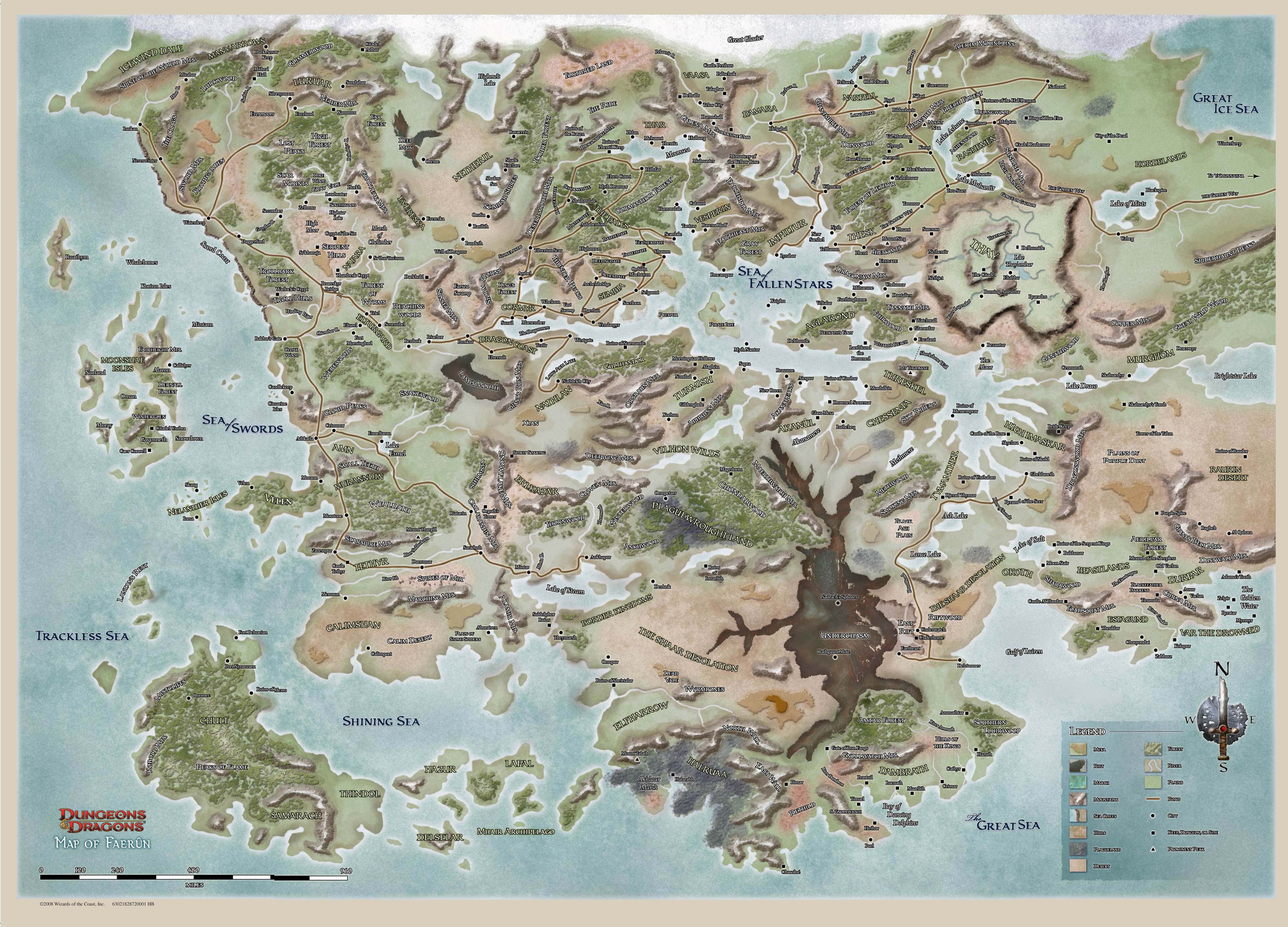
4th edition makes a decent attempt at flavour with a more grainy 'painted' map.
But in the end falls flat with a colour palette that is too bland and indistinct and a style that is too obviously digital.

At least the 3rd edition map gets colour composition and contrast right - Too bad the actual drawings are about as evocative as a box of coal. In the end, it detracts from the substance as well, as I am frankly less interested in studying the map and its contents in more detail. And I am left with the impression that there are areas drawn that could have been evocative with another style that just aren't in this map.

Style: 2/5
Substance: 5/5